|
||
| Products Download Events Support Videos | ||

Technical Support
On-Line Manuals
RL-ARM User's Guide (MDK v4)
 RL-RTX
 RL-FlashFS
 Technical Data
NAND Flash Translation Layer
Embedded File System
Memory Organization
Allocation Information
File Data Fragments
Limitations
Configuring RL-FlashFS
Source Files
Configuration Options
File System
Flash Drive
SPI Flash Drive
RAM Drive
Memory Card Drive
USB Flash Drive
NAND Flash Drive
Using RL-FlashFS
Using Flash Devices
Flash Driver
Sector Layout
Converting FlashPrg.c
Converting FlashDev.c
Limitations When Using Internal Flash
Using SPI Flash Devices
SPI Flash Driver
SPI Sector Layout
Using RAM Devices
Using Memory Card Devices
MCI Driver
SPI Driver
Using FlashFS with USB Devices
FAT Driver
Using NAND Devices
NAND Driver
NAND Page Data Layout
Function Overview
File I/O Routines
File Maintenance Routines
File Time Support Routines
Flash Driver Routines
FAT Driver Routines
MCI Driver Routines
SPI Driver Routines
NAND Driver Routines
IOC Interface Routines
System Routines
RL-TCPnet
RL-CAN
RL-USB
Example Programs
Library Reference
Appendix
Technical Data
NAND Flash Translation Layer
Embedded File System
Memory Organization
Allocation Information
File Data Fragments
Limitations
Configuring RL-FlashFS
Source Files
Configuration Options
File System
Flash Drive
SPI Flash Drive
RAM Drive
Memory Card Drive
USB Flash Drive
NAND Flash Drive
Using RL-FlashFS
Using Flash Devices
Flash Driver
Sector Layout
Converting FlashPrg.c
Converting FlashDev.c
Limitations When Using Internal Flash
Using SPI Flash Devices
SPI Flash Driver
SPI Sector Layout
Using RAM Devices
Using Memory Card Devices
MCI Driver
SPI Driver
Using FlashFS with USB Devices
FAT Driver
Using NAND Devices
NAND Driver
NAND Page Data Layout
Function Overview
File I/O Routines
File Maintenance Routines
File Time Support Routines
Flash Driver Routines
FAT Driver Routines
MCI Driver Routines
SPI Driver Routines
NAND Driver Routines
IOC Interface Routines
System Routines
RL-TCPnet
RL-CAN
RL-USB
Example Programs
Library Reference
Appendix
Using Memory Card Devices
Using Memory Card Device explains the steps to create applications for devices that support the FAT file system. RL-FlashFS supports standard Flash memory cards up to 32 GBytes.
Include into the project and configure the following source files:
-
The library that matches the device core:
FS_CM3.lib for Cortex-M devices.
FS_ARM_L.lib for ARM7 or ARM9 devices. -
The corresponding driver file
MCI_device family.c containing the functions for Flash memory cards.
SPI_device family.c containing the functions for SPI devices. -
The configuration files:
File_Config.c for configuring the device.
Retarget.c for configuring the output. -
The main file for initializing and connecting the
Flash device.
#include <RTL.h> int main (void) { ... init_card (); // initialize the device while (1) { ... // add the code init_card () // check if card removed ... // add the code } } -
When accessing files located in sub-directories, a complete
path must be specified. For example:
fopen ("logs\\work\\temp.log","r");
Applications can be created using existing µVision projects as templates.
- Copy all files from any folder \ARM\Boards\vendor\board\RL\FlashFS\SD_File to a new folder and open the project *.uvproj with µVision. RTX projects are using the RTX-RTOS. However, the configuration does not differ.
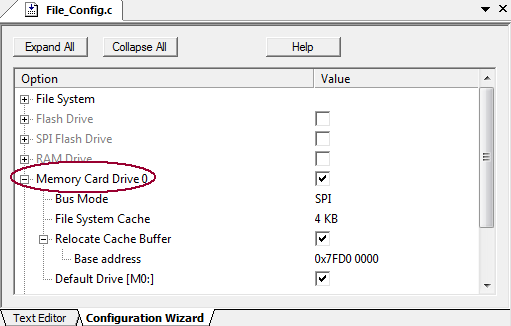
- Open the file File_Config.c and configure the Flash device using the Configuration Wizard.
-
Enable Memory Card Drive and set the device
characteristics.
- File Time Support Routines might need adaptation to set time stamp for the file.
- Modify the code to the application needs.
Note
- Memory Card Drive described the configuration options for MCI and SPI devices.
ProductsDevelopment Tools |
Hardware & Collateral |
Downloads |
Support |
Contact |
 |
||||