|
||
| Products Download Events Support Videos | ||

Product Information
Device Database®
Downloads
Compliance Testing
Distributors
Peripheral Simulation
For Atmel AT91SAM9260 — USARTs 0-5
Simulation support for this peripheral or feature is comprised of:
- Dialog boxes which display and allow you to change peripheral configuration.
These simulation capabilities are described below.
USART 0 Dialog
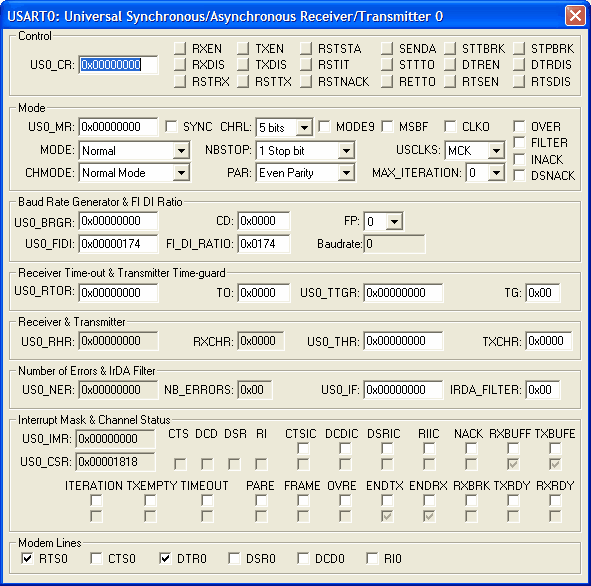
The USART 0 Dialog configures USART 0. A USART transfers serial data to and from external devices and the ARM controller. The USART can be configured in a variety of ways to suit the external serial device.
Control
- US0_CR (USART 0 Control Register) displays the combined control information for the following:
- RXEN (Receiver Enable) enables the receiver.
- TXEN (Transmitter Enable) enables the transmitter.
- RXDIS (Receiver Disable) disables the receiver.
- TXDIS (Transmitter Disable) disables the transmitter.
- RSTRX (Reset Receiver) resets the receiver.
- RSTTX (Reset Transmitter) resets the transmitter.
- RSTSTA (Reset Status Bits) resets the Parity Error (PARE), Framing Error (FRAME), Overrun Error (OVRE) and Break Received (RXBRK) status bits.
- SENDA (Send Address) sets the address bit with the next character written (multi-drop mode only).
- RSTIT (Reset Iterations) resets the Iteration status.
- STTTO (Start Time-out) restarts the wait time-out for a new character.
- RSTNACK (Reset Non Acknowledge) resets the Non Acknowledge status.
- RETTO (Reload and Start Time-out) restarts the receiver time-out counter.
- STTBRK (Start Break) generates a break condition after the next character is sent.
- STPBRK (Stop Break) cancels a break condition.
- DTREN (Data Terminal Ready Enable) drives the DTR pin to 0.
- DTRDIS (Data Terminal Ready Disable) drives the DTR pin to 1.
- RTSEN (Request to Send Enable) drives the RTS pin to 0.
- RTSDIS (Request to Send Disable) drives the RTS pin to 1.
Mode
- US0_MR (Mode Register) contains the USART Mode settings which is determined by settings of other controls in this group.
- MODE (USART Mode) configures the USART for normal, RS485, hardware handshake, modem, ISO7816 Protocol: T=0, ISO7816 Protocol: T=1 or IrDA mode.
- CHMODE (Channel Mode) selects normal, loopback, echo or remote loopback pin configurations.
- SYNC (Synchronous Mode Select) enables Synchronous mode.
- CHRL (Character Length) selects the number of bits per character.
- NBSTOP (Number of Stop Bits) selects the number of stop bits to be sent with each character.
- PAR (Parity Type) selects the generation of even, odd or no parity bits, mark or space, or multi-drop mode.
- Mode 9 (9-bit Mode) is set to use 9 data bits for character length. If reset, CHRL determines character length.
- MBSF (Most Significant Bit First) is set to send or receive the most significant bit first. If reset, the least significant bit first is sent or expected.
- CLKO (Clock Output Select) when set, drives the SCK pin if the external clock is not selected.
- USCLKS (Clock Selection) selects clock source and type.
- MAX_ITERATION (Maximum Number of Iterations) configures the maximum number of iterations when using mode ISO7816, protocol T=0.
- OVER (Oversampling Mode) is set to use 8x oversampling. If reset, the USART uses 16x oversampling.
- FILTER (Infrared Line Receive Filter) is set to enable the USART's three-sample filter.
- INACK (Inhibit Non Acknowledge) is set to suppress NACK generation.
- DSNACK (Disable Successive NACK) is set to count successive parity errors up to the MAX_ITERATION value. If that value is reached, the ITERATION bit is set.
Baudrate Generator & FI DI Ratio
- US0_BRGR (Baud Rate Generator Register) holds the Clock Divisor (CD) value.
- CD (Clock Divisor) contains the value divided into the clock that determines the baud rate.
- Baudrate displays the baud rate calculated by the USART.
- US0_FIDI (FI DI Register) contains the clock frequency division factor (FI) over the bit-rate adjustment factor (DI) for ISO7816 mode.
- US0_FIDI_RATIO (FI Over DI Ratio) contains the value divided into the SCK to determine the IOS7816 baudrate.
Receiver Time-out & Transmitter Time-guard
- US0_RTOR (Receiver Time-out Register) holds the receiver time-out value.
- TO (Time Out) sets the time-out counter value used with the Start Time-out command.
- US0_TTGR (Transmitter Time-guard Register) holds the transmitter time guard value.
- TG (Time-guard) sets the length of time TXD is inactive after each character.
Receiver & Transmitter
- US0_RHR (Receiver Holding Register) contains the RXCHR character.
- RXCHR (Received Character) holds the last character received.
- US0_THR (Transmitter Holding Register) contains the TXCHR character.
- TXCHR (Character to be Transmitted) holds the next character to be transmitted.
Number of Errors and IrDA Filter
- US0_NER (Number of Errors Register) contains the NB_ERRORS value.
- NB_ERRORS (Number of Errors) contains the total number of errors that occurred during an ISO7816 data transfer. This register is cleared when read.
- US0_IF (IrDA Filter) contains the IRDA_FILTER value.
- IRDA_FILTER (IrDA Filter) contains the 8-bit down counter value used for demodulation of the received signal.
Interrupt Mask & Channel Status
- US0_IMR (Interrupt Mask Register) holds the masking bits for all of the internal peripheral interrupts.
- US0_CSR (Channel Status Register) holds the composite status for the USART channel.
- CTS (Clear to Send pin) displays the CTS pin status.
- DCD (Data Carrier Detect pin) displays the DCD pin status.
- DSR (Data Set Ready pin) displays the DSR pin status.
- RI (Ring Indicator pin) displays the RI pin status.
- CTSIC (Clear to Send Input Change Flag) is set if at least 1 input change on CTS is detected.
- DCDIC (Data Carrier Detect Input Change Flag) is set if at least 1 input change on DCD is detected.
- DSRIC (Data Set Ready Input Change Flag) is set if at least 1 input change on DSR is detected.
- RIIC (Ring Indicator Input Change Flag) is set if at least 1 input change on RI is detected.
- NACK (Non Acknowledge Flag) is set if at least one NACK is detected.
- RXBUFF (Receive Buffer Full) is set if the Buffer Full signal from the PDC is active.
- TXBUFF (Transmit Buffer Full) is set if the Buffer Empty signal from the PDC is active.
- ITERATION (Iteration Flag) set if more than the maximum number of parity errors has occurred.
- TXEMPTY (Transmitter Empty) set if there are no characters in the transmitter hold register(US0_THR).
- TIMEOUT (Receiver Time-out) set if a Start Time-out counter has elapsed.
- PARE (Parity Error) set if the controller detects at least 1 false parity bit since the last Reset Status Bits command (RSTSTA).
- FRAME (Framing Error) set if the controller detects a framing error since the last Reset Status Bits command (RSTSTA).
- OVRE (Overrun Error) set if the controller detects an overrun condition since the last Reset Status Bits command (RSTSTA).
- ENDTX (End of Transmitter Transfer) is set if the End of Transmitter signal is active.
- ENDRX (End of Receiver Transfer) is set if the End of Receiver signal is active.
- RXBRK (Break Received/End of Break) is set if the USART receives a break since the last Reset Status Bits command (RSTSTA).
- TXRDY (Transmitter Ready) set if the transmit hold register (US0_THR) is empty and there is no break request pending.
- RXRDY (Receiver Ready) set when the USART receives at least 1 character and the receiver hold register (US0_RHR) is not empty.
Modem Lines
- RTS0 (Request to Send) displays the RTS pin status.
- CTS0 (Clear to Send) displays the CTS pin status.
USART 1 Dialog
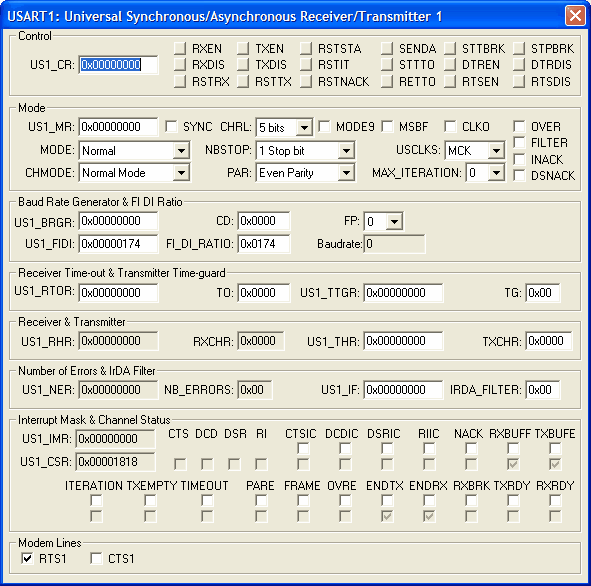
The USART 1 Dialog configures USART 1. A USART transfers serial data to and from external devices and the ARM controller. The USART can be configured in a variety of ways to suit the external serial device.
Control
- US1_CR (USART 1 Control Register) displays the combined control information for the following:
- RXEN (Receiver Enable) enables the receiver.
- TXEN (Transmitter Enable) enables the transmitter.
- RXDIS (Receiver Disable) disables the receiver.
- TXDIS (Transmitter Disable) disables the transmitter.
- RSTRX (Reset Receiver) resets the receiver.
- RSTTX (Reset Transmitter) resets the transmitter.
- RSTSTA (Reset Status Bits) resets the Parity Error (PARE), Framing Error (FRAME), Overrun Error (OVRE) and Break Received (RXBRK) status bits.
- SENDA (Send Address) sets the address bit with the next character written (multi-drop mode only).
- RSTIT (Reset Iterations) resets the Iteration status.
- STTTO (Start Time-out) restarts the wait time-out for a new character.
- RSTNACK (Reset Non Acknowledge) resets the Non Acknowledge status.
- RETTO (Reload and Start Time-out) restarts the receiver time-out counter.
- STTBRK (Start Break) generates a break condition after the next character is sent.
- STPBRK (Stop Break) cancels a break condition.
- DTREN (Data Terminal Ready Enable) drives the DTR pin to 0.
- DTRDIS (Data Terminal Ready Disable) drives the DTR pin to 1.
- RTSEN (Request to Send Enable) drives the RTS pin to 0.
- RTSDIS (Request to Send Disable) drives the RTS pin to 1.
Mode
- US1_MR (Mode Register) contains the USART Mode settings which is determined by settings of other controls in this group.
- MODE (USART Mode) configures the USART for normal, RS485, hardware handshake, modem, ISO7816 Protocol: T=0, ISO7816 Protocol: T=1 or IrDA mode.
- CHMODE (Channel Mode) selects normal, loopback, echo or remote loopback pin configurations.
- SYNC (Synchronous Mode Select) enables Synchronous mode.
- CHRL (Character Length) selects the number of bits per character.
- NBSTOP (Number of Stop Bits) selects the number of stop bits to be sent with each character.
- PAR (Parity Type) selects the generation of even, odd or no parity bits, mark or space, or multi-drop mode.
- Mode 9 (9-bit Mode) is set to use 9 data bits for character length. If reset, CHRL determines character length.
- MBSF (Most Significant Bit First) is set to send or receive the most significant bit first. If reset, the least significant bit first is sent or expected.
- CLKO (Clock Output Select) when set, drives the SCK pin if the external clock is not selected.
- USCLKS (Clock Selection) selects clock source and type.
- MAX_ITERATION (Maximum Number of Iterations) configures the maximum number of iterations when using mode ISO7816, protocol T=0.
- OVER (Oversampling Mode) is set to use 8x oversampling. If reset, the USART uses 16x oversampling.
- FILTER (Infrared Line Receive Filter) is set to enable the USART's three-sample filter.
- INACK (Inhibit Non Acknowledge) is set to suppress NACK generation.
- DSNACK (Disable Successive NACK) is set to count successive parity errors up to the MAX_ITERATION value. If that value is reached, the ITERATION bit is set.
Baudrate Generator & FI DI Ratio
- US1_BRGR (Baud Rate Generator Register) holds the Clock Divisor (CD) value.
- CD (Clock Divisor) contains the value divided into the clock that determines the baud rate.
- Baudrate displays the baud rate calculated by the USART.
- US1_FIDI (FI DI Register) contains the clock frequency division factor (FI) over the bit-rate adjustment factor (DI) for ISO7816 mode.
- US1_FIDI_RATIO (FI Over DI Ratio) contains the value divided into the SCK to determine the IOS7816 baudrate.
Receiver Time-out & Transmitter Time-guard
- US1_RTOR (Receiver Time-out Register) holds the receiver time-out value.
- TO (Time Out) sets the time-out counter value used with the Start Time-out command.
- US1_TTGR (Transmitter Time-guard Register) holds the transmitter time guard value.
- TG (Time-guard) sets the length of time TXD is inactive after each character.
Receiver & Transmitter
- US1_RHR (Receiver Holding Register) contains the RXCHR character.
- RXCHR (Received Character) holds the last character received.
- US1_THR (Transmitter Holding Register) contains the TXCHR character.
- TXCHR (Character to be Transmitted) holds the next character to be transmitted.
Number of Errors and IrDA Filter
- US1_NER (Number of Errors Register) contains the NB_ERRORS value.
- NB_ERRORS (Number of Errors) contains the total number of errors that occurred during an ISO7816 data transfer. This register is cleared when read.
- US1_IF (IrDA Filter) contains the IRDA_FILTER value.
- IRDA_FILTER (IrDA Filter) contains the 8-bit down counter value used for demodulation of the received signal.
Interrupt Mask & Channel Status
- US1_IMR (Interrupt Mask Register) holds the masking bits for all of the internal peripheral interrupts.
- US1_CSR (Channel Status Register) holds the composite status for the USART channel.
- CTS (Clear to Send pin) displays the CTS pin status.
- DCD (Data Carrier Detect pin) displays the DCD pin status.
- DSR (Data Set Ready pin) displays the DSR pin status.
- RI (Ring Indicator pin) displays the RI pin status.
- CTSIC (Clear to Send Input Change Flag) is set if at least 1 input change on CTS is detected.
- DCDIC (Data Carrier Detect Input Change Flag) is set if at least 1 input change on DCD is detected.
- DSRIC (Data Set Ready Input Change Flag) is set if at least 1 input change on DSR is detected.
- RIIC (Ring Indicator Input Change Flag) is set if at least 1 input change on RI is detected.
- NACK (Non Acknowledge Flag) is set if at least one NACK is detected.
- RXBUFF (Receive Buffer Full) is set if the Buffer Full signal from the PDC is active.
- TXBUFF (Transmit Buffer Full) is set if the Buffer Empty signal from the PDC is active.
- ITERATION (Iteration Flag) set if more than the maximum number of parity errors has occurred.
- TXEMPTY (Transmitter Empty) set if there are no characters in the transmitter hold register(US1_THR).
- TIMEOUT (Receiver Time-out) set if a Start Time-out counter has elapsed.
- PARE (Parity Error) set if the controller detects at least 1 false parity bit since the last Reset Status Bits command (RSTSTA).
- FRAME (Framing Error) set if the controller detects a framing error since the last Reset Status Bits command (RSTSTA).
- OVRE (Overrun Error) set if the controller detects an overrun condition since the last Reset Status Bits command (RSTSTA).
- ENDTX (End of Transmitter Transfer) is set if the End of Transmitter signal is active.
- ENDRX (End of Receiver Transfer) is set if the End of Receiver signal is active.
- RXBRK (Break Received/End of Break) is set if the USART receives a break since the last Reset Status Bits command (RSTSTA).
- TXRDY (Transmitter Ready) set if the transmit hold register (US1_THR) is empty and there is no break request pending.
- RXRDY (Receiver Ready) set when the USART receives at least 1 character and the receiver hold register (US1_RHR) is not empty.
Modem Lines
- RTS1 (Request to Send) displays the RTS pin status.
- CTS1 (Clear to Send) displays the CTS pin status.
- DTR1 (Data Terminal Ready) displays the DTR pin status.
- DSR1 (Data Set Ready) displays the DSR pin status.
- DCD1 (Data Carrier Detect) displays the DCD pin status.
- RI1 (Ring Indicator) displays the RI pin status.
USART 2 Dialog
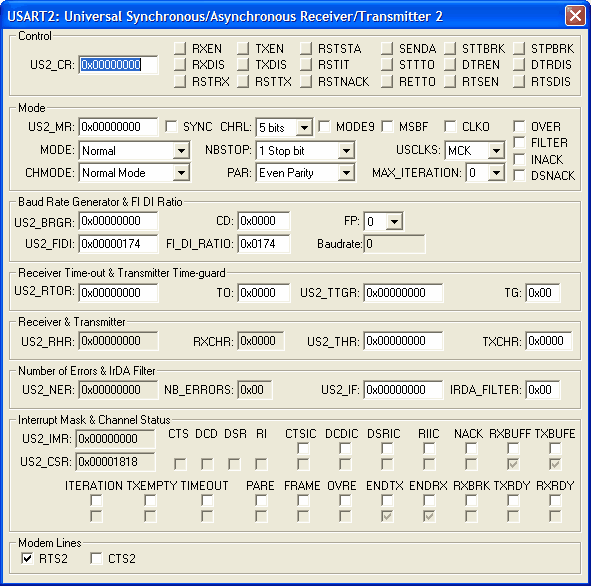
The USART 2 Dialog configures USART 2. A USART transfers serial data to and from external devices and the ARM controller. The USART can be configured in a variety of ways to suit the external serial device.
Control
- US2_CR (USART 2 Control Register) displays the combined control information for the following:
- RXEN (Receiver Enable) enables the receiver.
- TXEN (Transmitter Enable) enables the transmitter.
- RXDIS (Receiver Disable) disables the receiver.
- TXDIS (Transmitter Disable) disables the transmitter.
- RSTRX (Reset Receiver) resets the receiver.
- RSTTX (Reset Transmitter) resets the transmitter.
- RSTSTA (Reset Status Bits) resets the Parity Error (PARE), Framing Error (FRAME), Overrun Error (OVRE) and Break Received (RXBRK) status bits.
- SENDA (Send Address) sets the address bit with the next character written (multi-drop mode only).
- RSTIT (Reset Iterations) resets the Iteration status.
- STTTO (Start Time-out) restarts the wait time-out for a new character.
- RSTNACK (Reset Non Acknowledge) resets the Non Acknowledge status.
- RETTO (Reload and Start Time-out) restarts the receiver time-out counter.
- STTBRK (Start Break) generates a break condition after the next character is sent.
- STPBRK (Stop Break) cancels a break condition.
- DTREN (Data Terminal Ready Enable) drives the DTR pin to 0.
- DTRDIS (Data Terminal Ready Disable) drives the DTR pin to 1.
- RTSEN (Request to Send Enable) drives the RTS pin to 0.
- RTSDIS (Request to Send Disable) drives the RTS pin to 1.
Mode
- US2_MR (Mode Register) contains the USART Mode settings which is determined by settings of other controls in this group.
- MODE (USART Mode) configures the USART for normal, RS485, hardware handshake, modem, ISO7816 Protocol: T=0, ISO7816 Protocol: T=1 or IrDA mode.
- CHMODE (Channel Mode) selects normal, loopback, echo or remote loopback pin configurations.
- SYNC (Synchronous Mode Select) enables Synchronous mode.
- CHRL (Character Length) selects the number of bits per character.
- NBSTOP (Number of Stop Bits) selects the number of stop bits to be sent with each character.
- PAR (Parity Type) selects the generation of even, odd or no parity bits, mark or space, or multi-drop mode.
- Mode 9 (9-bit Mode) is set to use 9 data bits for character length. If reset, CHRL determines character length.
- MBSF (Most Significant Bit First) is set to send or receive the most significant bit first. If reset, the least significant bit first is sent or expected.
- CLKO (Clock Output Select) when set, drives the SCK pin if the external clock is not selected.
- USCLKS (Clock Selection) selects clock source and type.
- MAX_ITERATION (Maximum Number of Iterations) configures the maximum number of iterations when using mode ISO7816, protocol T=0.
- OVER (Oversampling Mode) is set to use 8x oversampling. If reset, the USART uses 16x oversampling.
- FILTER (Infrared Line Receive Filter) is set to enable the USART's three-sample filter.
- INACK (Inhibit Non Acknowledge) is set to suppress NACK generation.
- DSNACK (Disable Successive NACK) is set to count successive parity errors up to the MAX_ITERATION value. If that value is reached, the ITERATION bit is set.
Baudrate Generator & FI DI Ratio
- US2_BRGR (Baud Rate Generator Register) holds the Clock Divisor (CD) value.
- CD (Clock Divisor) contains the value divided into the clock that determines the baud rate.
- Baudrate displays the baud rate calculated by the USART.
- US2_FIDI (FI DI Register) contains the clock frequency division factor (FI) over the bit-rate adjustment factor (DI) for ISO7816 mode.
- US2_FIDI_RATIO (FI Over DI Ratio) contains the value divided into the SCK to determine the IOS7816 baudrate.
Receiver Time-out & Transmitter Time-guard
- US2_RTOR (Receiver Time-out Register) holds the receiver time-out value.
- TO (Time Out) sets the time-out counter value used with the Start Time-out command.
- US2_TTGR (Transmitter Time-guard Register) holds the transmitter time guard value.
- TG (Time-guard) sets the length of time TXD is inactive after each character.
Receiver & Transmitter
- US2_RHR (Receiver Holding Register) contains the RXCHR character.
- RXCHR (Received Character) holds the last character received.
- US2_THR (Transmitter Holding Register) contains the TXCHR character.
- TXCHR (Character to be Transmitted) holds the next character to be transmitted.
Number of Errors and IrDA Filter
- US2_NER (Number of Errors Register) contains the NB_ERRORS value.
- NB_ERRORS (Number of Errors) contains the total number of errors that occurred during an ISO7816 data transfer. This register is cleared when read.
- US2_IF (IrDA Filter) contains the IRDA_FILTER value.
- IRDA_FILTER (IrDA Filter) contains the 8-bit down counter value used for demodulation of the received signal.
Interrupt Mask & Channel Status
- US2_IMR (Interrupt Mask Register) holds the masking bits for all of the internal peripheral interrupts.
- US2_CSR (Channel Status Register) holds the composite status for the USART channel.
- CTS (Clear to Send pin) displays the CTS pin status.
- DCD (Data Carrier Detect pin) displays the DCD pin status.
- DSR (Data Set Ready pin) displays the DSR pin status.
- RI (Ring Indicator pin) displays the RI pin status.
- CTSIC (Clear to Send Input Change Flag) is set if at least 1 input change on CTS is detected.
- DCDIC (Data Carrier Detect Input Change Flag) is set if at least 1 input change on DCD is detected.
- DSRIC (Data Set Ready Input Change Flag) is set if at least 1 input change on DSR is detected.
- RIIC (Ring Indicator Input Change Flag) is set if at least 1 input change on RI is detected.
- NACK (Non Acknowledge Flag) is set if at least one NACK is detected.
- RXBUFF (Receive Buffer Full) is set if the Buffer Full signal from the PDC is active.
- TXBUFF (Transmit Buffer Full) is set if the Buffer Empty signal from the PDC is active.
- ITERATION (Iteration Flag) set if more than the maximum number of parity errors has occurred.
- TXEMPTY (Transmitter Empty) set if there are no characters in the transmitter hold register(US2_THR).
- TIMEOUT (Receiver Time-out) set if a Start Time-out counter has elapsed.
- PARE (Parity Error) set if the controller detects at least 1 false parity bit since the last Reset Status Bits command (RSTSTA).
- FRAME (Framing Error) set if the controller detects a framing error since the last Reset Status Bits command (RSTSTA).
- OVRE (Overrun Error) set if the controller detects an overrun condition since the last Reset Status Bits command (RSTSTA).
- ENDTX (End of Transmitter Transfer) is set if the End of Transmitter signal is active.
- ENDRX (End of Receiver Transfer) is set if the End of Receiver signal is active.
- RXBRK (Break Received/End of Break) is set if the USART receives a break since the last Reset Status Bits command (RSTSTA).
- TXRDY (Transmitter Ready) set if the transmit hold register (US2_THR) is empty and there is no break request pending.
- RXRDY (Receiver Ready) set when the USART receives at least 1 character and the receiver hold register (US2_RHR) is not empty.
Modem Lines
- RTS2 (Request to Send) displays the RTS pin status.
- CTS2 (Clear to Send) displays the CTS pin status.
USART 3 Dialog
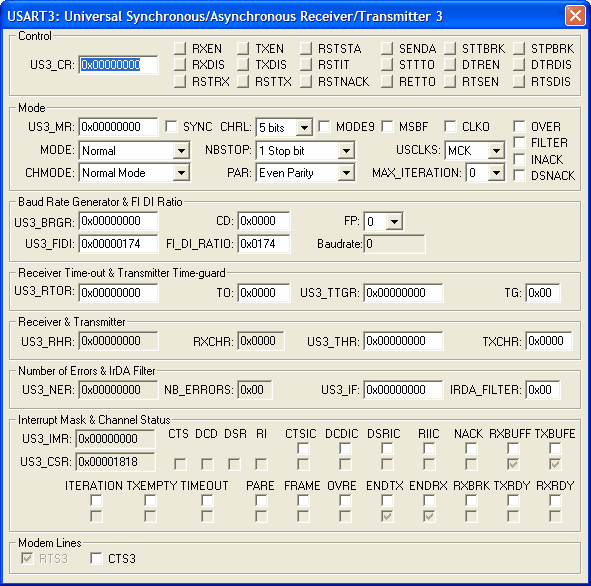
The USART 3 Dialog configures USART 3. A USART transfers serial data to and from external devices and the ARM controller. The USART can be configured in a variety of ways to suit the external serial device.
Control
- US3_CR (USART 3 Control Register) displays the combined control information for the following:
- RXEN (Receiver Enable) enables the receiver.
- TXEN (Transmitter Enable) enables the transmitter.
- RXDIS (Receiver Disable) disables the receiver.
- TXDIS (Transmitter Disable) disables the transmitter.
- RSTRX (Reset Receiver) resets the receiver.
- RSTTX (Reset Transmitter) resets the transmitter.
- RSTSTA (Reset Status Bits) resets the Parity Error (PARE), Framing Error (FRAME), Overrun Error (OVRE) and Break Received (RXBRK) status bits.
- SENDA (Send Address) sets the address bit with the next character written (multi-drop mode only).
- RSTIT (Reset Iterations) resets the Iteration status.
- STTTO (Start Time-out) restarts the wait time-out for a new character.
- RSTNACK (Reset Non Acknowledge) resets the Non Acknowledge status.
- RETTO (Reload and Start Time-out) restarts the receiver time-out counter.
- STTBRK (Start Break) generates a break condition after the next character is sent.
- STPBRK (Stop Break) cancels a break condition.
- DTREN (Data Terminal Ready Enable) drives the DTR pin to 0.
- DTRDIS (Data Terminal Ready Disable) drives the DTR pin to 1.
- RTSEN (Request to Send Enable) drives the RTS pin to 0.
- RTSDIS (Request to Send Disable) drives the RTS pin to 1.
Mode
- US3_MR (Mode Register) contains the USART Mode settings which is determined by settings of other controls in this group.
- MODE (USART Mode) configures the USART for normal, RS485, hardware handshake, modem, ISO7816 Protocol: T=0, ISO7816 Protocol: T=1 or IrDA mode.
- CHMODE (Channel Mode) selects normal, loopback, echo or remote loopback pin configurations.
- SYNC (Synchronous Mode Select) enables Synchronous mode.
- CHRL (Character Length) selects the number of bits per character.
- NBSTOP (Number of Stop Bits) selects the number of stop bits to be sent with each character.
- PAR (Parity Type) selects the generation of even, odd or no parity bits, mark or space, or multi-drop mode.
- Mode 9 (9-bit Mode) is set to use 9 data bits for character length. If reset, CHRL determines character length.
- MBSF (Most Significant Bit First) is set to send or receive the most significant bit first. If reset, the least significant bit first is sent or expected.
- CLKO (Clock Output Select) when set, drives the SCK pin if the external clock is not selected.
- USCLKS (Clock Selection) selects clock source and type.
- MAX_ITERATION (Maximum Number of Iterations) configures the maximum number of iterations when using mode ISO7816, protocol T=0.
- OVER (Oversampling Mode) is set to use 8x oversampling. If reset, the USART uses 16x oversampling.
- FILTER (Infrared Line Receive Filter) is set to enable the USART's three-sample filter.
- INACK (Inhibit Non Acknowledge) is set to suppress NACK generation.
- DSNACK (Disable Successive NACK) is set to count successive parity errors up to the MAX_ITERATION value. If that value is reached, the ITERATION bit is set.
Baudrate Generator & FI DI Ratio
- US3_BRGR (Baud Rate Generator Register) holds the Clock Divisor (CD) value.
- CD (Clock Divisor) contains the value divided into the clock that determines the baud rate.
- Baudrate displays the baud rate calculated by the USART.
- US3_FIDI (FI DI Register) contains the clock frequency division factor (FI) over the bit-rate adjustment factor (DI) for ISO7816 mode.
- US3_FIDI_RATIO (FI Over DI Ratio) contains the value divided into the SCK to determine the IOS7816 baudrate.
Receiver Time-out & Transmitter Time-guard
- US3_RTOR (Receiver Time-out Register) holds the receiver time-out value.
- TO (Time Out) sets the time-out counter value used with the Start Time-out command.
- US3_TTGR (Transmitter Time-guard Register) holds the transmitter time guard value.
- TG (Time-guard) sets the length of time TXD is inactive after each character.
Receiver & Transmitter
- US3_RHR (Receiver Holding Register) contains the RXCHR character.
- RXCHR (Received Character) holds the last character received.
- US3_THR (Transmitter Holding Register) contains the TXCHR character.
- TXCHR (Character to be Transmitted) holds the next character to be transmitted.
Number of Errors and IrDA Filter
- US3_NER (Number of Errors Register) contains the NB_ERRORS value.
- NB_ERRORS (Number of Errors) contains the total number of errors that occurred during an ISO7816 data transfer. This register is cleared when read.
- US3_IF (IrDA Filter) contains the IRDA_FILTER value.
- IRDA_FILTER (IrDA Filter) contains the 8-bit down counter value used for demodulation of the received signal.
Interrupt Mask & Channel Status
- US3_IMR (Interrupt Mask Register) holds the masking bits for all of the internal peripheral interrupts.
- US3_CSR (Channel Status Register) holds the composite status for the USART channel.
- CTS (Clear to Send pin) displays the CTS pin status.
- DCD (Data Carrier Detect pin) displays the DCD pin status.
- DSR (Data Set Ready pin) displays the DSR pin status.
- RI (Ring Indicator pin) displays the RI pin status.
- CTSIC (Clear to Send Input Change Flag) is set if at least 1 input change on CTS is detected.
- DCDIC (Data Carrier Detect Input Change Flag) is set if at least 1 input change on DCD is detected.
- DSRIC (Data Set Ready Input Change Flag) is set if at least 1 input change on DSR is detected.
- RIIC (Ring Indicator Input Change Flag) is set if at least 1 input change on RI is detected.
- NACK (Non Acknowledge Flag) is set if at least one NACK is detected.
- RXBUFF (Receive Buffer Full) is set if the Buffer Full signal from the PDC is active.
- TXBUFF (Transmit Buffer Full) is set if the Buffer Empty signal from the PDC is active.
- ITERATION (Iteration Flag) set if more than the maximum number of parity errors has occurred.
- TXEMPTY (Transmitter Empty) set if there are no characters in the transmitter hold register(US3_THR).
- TIMEOUT (Receiver Time-out) set if a Start Time-out counter has elapsed.
- PARE (Parity Error) set if the controller detects at least 1 false parity bit since the last Reset Status Bits command (RSTSTA).
- FRAME (Framing Error) set if the controller detects a framing error since the last Reset Status Bits command (RSTSTA).
- OVRE (Overrun Error) set if the controller detects an overrun condition since the last Reset Status Bits command (RSTSTA).
- ENDTX (End of Transmitter Transfer) is set if the End of Transmitter signal is active.
- ENDRX (End of Receiver Transfer) is set if the End of Receiver signal is active.
- RXBRK (Break Received/End of Break) is set if the USART receives a break since the last Reset Status Bits command (RSTSTA).
- TXRDY (Transmitter Ready) set if the transmit hold register (US3_THR) is empty and there is no break request pending.
- RXRDY (Receiver Ready) set when the USART receives at least 1 character and the receiver hold register (US3_RHR) is not empty.
Modem Lines
- RTS3 (Request to Send) displays the RTS pin status.
- CTS3 (Clear to Send) displays the CTS pin status.
USART 4 Dialog
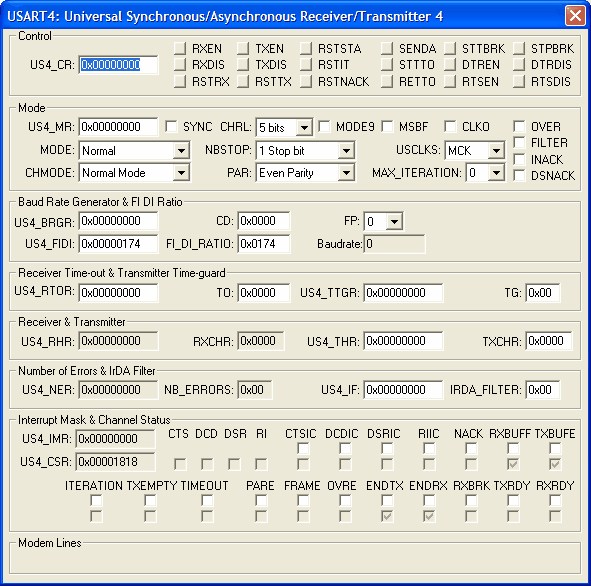
The USART 4 Dialog configures USART 4. A USART transfers serial data to and from external devices and the ARM controller. The USART can be configured in a variety of ways to suit the external serial device.
Control
- US4_CR (USART 4 Control Register) displays the combined control information for the following:
- RXEN (Receiver Enable) enables the receiver.
- TXEN (Transmitter Enable) enables the transmitter.
- RXDIS (Receiver Disable) disables the receiver.
- TXDIS (Transmitter Disable) disables the transmitter.
- RSTRX (Reset Receiver) resets the receiver.
- RSTTX (Reset Transmitter) resets the transmitter.
- RSTSTA (Reset Status Bits) resets the Parity Error (PARE), Framing Error (FRAME), Overrun Error (OVRE) and Break Received (RXBRK) status bits.
- SENDA (Send Address) sets the address bit with the next character written (multi-drop mode only).
- RSTIT (Reset Iterations) resets the Iteration status.
- STTTO (Start Time-out) restarts the wait time-out for a new character.
- RSTNACK (Reset Non Acknowledge) resets the Non Acknowledge status.
- RETTO (Reload and Start Time-out) restarts the receiver time-out counter.
- STTBRK (Start Break) generates a break condition after the next character is sent.
- STPBRK (Stop Break) cancels a break condition.
- DTREN (Data Terminal Ready Enable) drives the DTR pin to 0.
- DTRDIS (Data Terminal Ready Disable) drives the DTR pin to 1.
- RTSEN (Request to Send Enable) drives the RTS pin to 0.
- RTSDIS (Request to Send Disable) drives the RTS pin to 1.
Mode
- US4_MR (Mode Register) contains the USART Mode settings which is determined by settings of other controls in this group.
- MODE (USART Mode) configures the USART for normal, RS485, hardware handshake, modem, ISO7816 Protocol: T=0, ISO7816 Protocol: T=1 or IrDA mode.
- CHMODE (Channel Mode) selects normal, loopback, echo or remote loopback pin configurations.
- SYNC (Synchronous Mode Select) enables Synchronous mode.
- CHRL (Character Length) selects the number of bits per character.
- NBSTOP (Number of Stop Bits) selects the number of stop bits to be sent with each character.
- PAR (Parity Type) selects the generation of even, odd or no parity bits, mark or space, or multi-drop mode.
- Mode 9 (9-bit Mode) is set to use 9 data bits for character length. If reset, CHRL determines character length.
- MBSF (Most Significant Bit First) is set to send or receive the most significant bit first. If reset, the least significant bit first is sent or expected.
- CLKO (Clock Output Select) when set, drives the SCK pin if the external clock is not selected.
- USCLKS (Clock Selection) selects clock source and type.
- MAX_ITERATION (Maximum Number of Iterations) configures the maximum number of iterations when using mode ISO7816, protocol T=0.
- OVER (Oversampling Mode) is set to use 8x oversampling. If reset, the USART uses 16x oversampling.
- FILTER (Infrared Line Receive Filter) is set to enable the USART's three-sample filter.
- INACK (Inhibit Non Acknowledge) is set to suppress NACK generation.
- DSNACK (Disable Successive NACK) is set to count successive parity errors up to the MAX_ITERATION value. If that value is reached, the ITERATION bit is set.
Baudrate Generator & FI DI Ratio
- US4_BRGR (Baud Rate Generator Register) holds the Clock Divisor (CD) value.
- CD (Clock Divisor) contains the value divided into the clock that determines the baud rate.
- Baudrate displays the baud rate calculated by the USART.
- US4_FIDI (FI DI Register) contains the clock frequency division factor (FI) over the bit-rate adjustment factor (DI) for ISO7816 mode.
- US4_FIDI_RATIO (FI Over DI Ratio) contains the value divided into the SCK to determine the IOS7816 baudrate.
Receiver Time-out & Transmitter Time-guard
- US4_RTOR (Receiver Time-out Register) holds the receiver time-out value.
- TO (Time Out) sets the time-out counter value used with the Start Time-out command.
- US4_TTGR (Transmitter Time-guard Register) holds the transmitter time guard value.
- TG (Time-guard) sets the length of time TXD is inactive after each character.
Receiver & Transmitter
- US4_RHR (Receiver Holding Register) contains the RXCHR character.
- RXCHR (Received Character) holds the last character received.
- US4_THR (Transmitter Holding Register) contains the TXCHR character.
- TXCHR (Character to be Transmitted) holds the next character to be transmitted.
Number of Errors and IrDA Filter
- US4_NER (Number of Errors Register) contains the NB_ERRORS value.
- NB_ERRORS (Number of Errors) contains the total number of errors that occurred during an ISO7816 data transfer. This register is cleared when read.
- US4_IF (IrDA Filter) contains the IRDA_FILTER value.
- IRDA_FILTER (IrDA Filter) contains the 8-bit down counter value used for demodulation of the received signal.
Interrupt Mask & Channel Status
- US4_IMR (Interrupt Mask Register) holds the masking bits for all of the internal peripheral interrupts.
- US4_CSR (Channel Status Register) holds the composite status for the USART channel.
- CTS (Clear to Send pin) displays the CTS pin status.
- DCD (Data Carrier Detect pin) displays the DCD pin status.
- DSR (Data Set Ready pin) displays the DSR pin status.
- RI (Ring Indicator pin) displays the RI pin status.
- CTSIC (Clear to Send Input Change Flag) is set if at least 1 input change on CTS is detected.
- DCDIC (Data Carrier Detect Input Change Flag) is set if at least 1 input change on DCD is detected.
- DSRIC (Data Set Ready Input Change Flag) is set if at least 1 input change on DSR is detected.
- RIIC (Ring Indicator Input Change Flag) is set if at least 1 input change on RI is detected.
- NACK (Non Acknowledge Flag) is set if at least one NACK is detected.
- RXBUFF (Receive Buffer Full) is set if the Buffer Full signal from the PDC is active.
- TXBUFF (Transmit Buffer Full) is set if the Buffer Empty signal from the PDC is active.
- ITERATION (Iteration Flag) set if more than the maximum number of parity errors has occurred.
- TXEMPTY (Transmitter Empty) set if there are no characters in the transmitter hold register(US4_THR).
- TIMEOUT (Receiver Time-out) set if a Start Time-out counter has elapsed.
- PARE (Parity Error) set if the controller detects at least 1 false parity bit since the last Reset Status Bits command (RSTSTA).
- FRAME (Framing Error) set if the controller detects a framing error since the last Reset Status Bits command (RSTSTA).
- OVRE (Overrun Error) set if the controller detects an overrun condition since the last Reset Status Bits command (RSTSTA).
- ENDTX (End of Transmitter Transfer) is set if the End of Transmitter signal is active.
- ENDRX (End of Receiver Transfer) is set if the End of Receiver signal is active.
- RXBRK (Break Received/End of Break) is set if the USART receives a break since the last Reset Status Bits command (RSTSTA).
- TXRDY (Transmitter Ready) set if the transmit hold register (US4_THR) is empty and there is no break request pending.
- RXRDY (Receiver Ready) set when the USART receives at least 1 character and the receiver hold register (US4_RHR) is not empty.
USART 5 Dialog
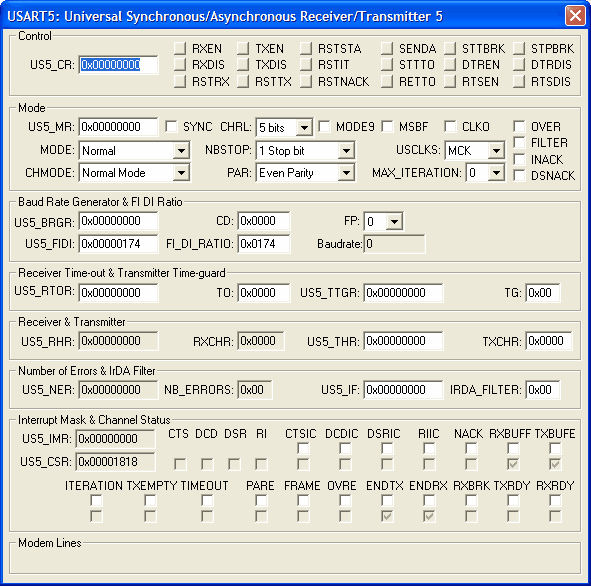
The USART 5 Dialog configures USART 5. A USART transfers serial data to and from external devices and the ARM controller. The USART can be configured in a variety of ways to suit the external serial device.
Control
- US5_CR (USART 5 Control Register) displays the combined control information for the following:
- RXEN (Receiver Enable) enables the receiver.
- TXEN (Transmitter Enable) enables the transmitter.
- RXDIS (Receiver Disable) disables the receiver.
- TXDIS (Transmitter Disable) disables the transmitter.
- RSTRX (Reset Receiver) resets the receiver.
- RSTTX (Reset Transmitter) resets the transmitter.
- RSTSTA (Reset Status Bits) resets the Parity Error (PARE), Framing Error (FRAME), Overrun Error (OVRE) and Break Received (RXBRK) status bits.
- SENDA (Send Address) sets the address bit with the next character written (multi-drop mode only).
- RSTIT (Reset Iterations) resets the Iteration status.
- STTTO (Start Time-out) restarts the wait time-out for a new character.
- RSTNACK (Reset Non Acknowledge) resets the Non Acknowledge status.
- RETTO (Reload and Start Time-out) restarts the receiver time-out counter.
- STTBRK (Start Break) generates a break condition after the next character is sent.
- STPBRK (Stop Break) cancels a break condition.
- DTREN (Data Terminal Ready Enable) drives the DTR pin to 0.
- DTRDIS (Data Terminal Ready Disable) drives the DTR pin to 1.
- RTSEN (Request to Send Enable) drives the RTS pin to 0.
- RTSDIS (Request to Send Disable) drives the RTS pin to 1.
Mode
- US5_MR (Mode Register) contains the USART Mode settings which is determined by settings of other controls in this group.
- MODE (USART Mode) configures the USART for normal, RS485, hardware handshake, modem, ISO7816 Protocol: T=0, ISO7816 Protocol: T=1 or IrDA mode.
- CHMODE (Channel Mode) selects normal, loopback, echo or remote loopback pin configurations.
- SYNC (Synchronous Mode Select) enables Synchronous mode.
- CHRL (Character Length) selects the number of bits per character.
- NBSTOP (Number of Stop Bits) selects the number of stop bits to be sent with each character.
- PAR (Parity Type) selects the generation of even, odd or no parity bits, mark or space, or multi-drop mode.
- Mode 9 (9-bit Mode) is set to use 9 data bits for character length. If reset, CHRL determines character length.
- MBSF (Most Significant Bit First) is set to send or receive the most significant bit first. If reset, the least significant bit first is sent or expected.
- CLKO (Clock Output Select) when set, drives the SCK pin if the external clock is not selected.
- USCLKS (Clock Selection) selects clock source and type.
- MAX_ITERATION (Maximum Number of Iterations) configures the maximum number of iterations when using mode ISO7816, protocol T=0.
- OVER (Oversampling Mode) is set to use 8x oversampling. If reset, the USART uses 16x oversampling.
- FILTER (Infrared Line Receive Filter) is set to enable the USART's three-sample filter.
- INACK (Inhibit Non Acknowledge) is set to suppress NACK generation.
- DSNACK (Disable Successive NACK) is set to count successive parity errors up to the MAX_ITERATION value. If that value is reached, the ITERATION bit is set.
Baudrate Generator & FI DI Ratio
- US5_BRGR (Baud Rate Generator Register) holds the Clock Divisor (CD) value.
- CD (Clock Divisor) contains the value divided into the clock that determines the baud rate.
- Baudrate displays the baud rate calculated by the USART.
- US5_FIDI (FI DI Register) contains the clock frequency division factor (FI) over the bit-rate adjustment factor (DI) for ISO7816 mode.
- US5_FIDI_RATIO (FI Over DI Ratio) contains the value divided into the SCK to determine the IOS7816 baudrate.
Receiver Time-out & Transmitter Time-guard
- US5_RTOR (Receiver Time-out Register) holds the receiver time-out value.
- TO (Time Out) sets the time-out counter value used with the Start Time-out command.
- US5_TTGR (Transmitter Time-guard Register) holds the transmitter time guard value.
- TG (Time-guard) sets the length of time TXD is inactive after each character.
Receiver & Transmitter
- US5_RHR (Receiver Holding Register) contains the RXCHR character.
- RXCHR (Received Character) holds the last character received.
- US5_THR (Transmitter Holding Register) contains the TXCHR character.
- TXCHR (Character to be Transmitted) holds the next character to be transmitted.
Number of Errors and IrDA Filter
- US5_NER (Number of Errors Register) contains the NB_ERRORS value.
- NB_ERRORS (Number of Errors) contains the total number of errors that occurred during an ISO7816 data transfer. This register is cleared when read.
- US5_IF (IrDA Filter) contains the IRDA_FILTER value.
- IRDA_FILTER (IrDA Filter) contains the 8-bit down counter value used for demodulation of the received signal.
Interrupt Mask & Channel Status
- US5_IMR (Interrupt Mask Register) holds the masking bits for all of the internal peripheral interrupts.
- US5_CSR (Channel Status Register) holds the composite status for the USART channel.
- CTS (Clear to Send pin) displays the CTS pin status.
- DCD (Data Carrier Detect pin) displays the DCD pin status.
- DSR (Data Set Ready pin) displays the DSR pin status.
- RI (Ring Indicator pin) displays the RI pin status.
- CTSIC (Clear to Send Input Change Flag) is set if at least 1 input change on CTS is detected.
- DCDIC (Data Carrier Detect Input Change Flag) is set if at least 1 input change on DCD is detected.
- DSRIC (Data Set Ready Input Change Flag) is set if at least 1 input change on DSR is detected.
- RIIC (Ring Indicator Input Change Flag) is set if at least 1 input change on RI is detected.
- NACK (Non Acknowledge Flag) is set if at least one NACK is detected.
- RXBUFF (Receive Buffer Full) is set if the Buffer Full signal from the PDC is active.
- TXBUFF (Transmit Buffer Full) is set if the Buffer Empty signal from the PDC is active.
- ITERATION (Iteration Flag) set if more than the maximum number of parity errors has occurred.
- TXEMPTY (Transmitter Empty) set if there are no characters in the transmitter hold register(US5_THR).
- TIMEOUT (Receiver Time-out) set if a Start Time-out counter has elapsed.
- PARE (Parity Error) set if the controller detects at least 1 false parity bit since the last Reset Status Bits command (RSTSTA).
- FRAME (Framing Error) set if the controller detects a framing error since the last Reset Status Bits command (RSTSTA).
- OVRE (Overrun Error) set if the controller detects an overrun condition since the last Reset Status Bits command (RSTSTA).
- ENDTX (End of Transmitter Transfer) is set if the End of Transmitter signal is active.
- ENDRX (End of Receiver Transfer) is set if the End of Receiver signal is active.
- RXBRK (Break Received/End of Break) is set if the USART receives a break since the last Reset Status Bits command (RSTSTA).
- TXRDY (Transmitter Ready) set if the transmit hold register (US5_THR) is empty and there is no break request pending.
- RXRDY (Receiver Ready) set when the USART receives at least 1 character and the receiver hold register (US5_RHR) is not empty.
ProductsDevelopment Tools |
Hardware & Collateral |
Downloads |
Support |
Contact |
 |
||||