|
||
| Products Download Events Support Videos | ||

Product Information
Device Database®
Downloads
Compliance Testing
Distributors
Peripheral Simulation
For Dallas Semiconductor DS89C430 — Serial UART (enhanced interface)
Simulation support for this peripheral or feature is comprised of:
- Dialog boxes which display and allow you to change peripheral configuration.
These simulation capabilities are described below.
Serial Channel Dialog
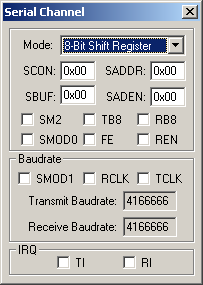
The Serial Channel dialog displays and allows you to edit the configuration of the Serial Interface.
- Mode displays and allows you to change the serial interface mode of operation (data bit length and baud rate).
- SCON (Serial Control Register) holds the control and setup information for programming the serial port.
- SBUF (Serial Interface Buffer Register) contains the transmit data to be sent or received data.
- SADDR (Slave Address) when the MCU is a master, this selects a slave device for communication with another serial device.
- SADEN (Slave Address Mask) determines which bits of the slave address are used for communication with another serial device.
- SM2 (Enable Serial Port Multiprocessor Communication In Modes 2 and 3) is set to suppress a receiver interrupt (RI) if the received 9th data bit is 0.
- TB8 (Serial Port Transmitter Bit 9) is the 9th data bit to be transmitted for serial modes 2 and 3.
- RB8 (Serial Port Receiver Bit 9) is set for serial modes 2 and 3 when a 9th bit is received. In serial mode 1, this is the stop bit.
- SMOD0 (Framing Error Mode) is set to enable framing error detection for serial channels 0 and 1.
- FE (Framing Error Detected) is set when an invalid stop bit (framing error) is detected. This bit must be reset by software.
- REN (Receiver Enable) is set to enable serial data input.
BaudRate
- SMOD1 (Double Baudrate) is set to double the baudrate in mode 2.
- RCLK (Receive Clock Enable) is set to use Timer 2 overflows for the receive clock. If reset, Timer 1 overflows are used.
- TCLK (Transmit Clock Enable) is set to use Timer 2 overflows for the transmit clock. If reset, Timer 1 overflows are used.
- Transmit & Receive Baudrate is the actual baudrate for the serial channel. It can be derived from the oscillator frequency, or generated by Timer 1.
IRQ
- TI (Transmitter Interrupt Flag) is set by hardware for each character frame transmitted. TI is cleared by software.
- RI (Receiver Interrupt Flag) is set by hardware for each character frame received. RI is cleared by software.
ProductsDevelopment Tools |
Hardware & Collateral |
Downloads |
Support |
Contact |
 |
||||